Every major Western compliance platform has the same architecture. A brand mandates Chinese suppliers to upload production data into a centrally-controlled database - audit records, material certifications, emissions data - and that data sits on servers producers don't control. It's 'standard'.
That standard is over.
On 31 March 2026, Premier Li Qiang signed State Council Order No. 834 - the Provisions of the State Council on the Security of Industrial Chains and Supply Chains - which took immediate effect.
It is China's first dedicated administrative regulation on industrial and supply chain security, and it marks a significant elevation of supply chain security from an economic priority to a matter of national security.
The regulation is eighteen articles that establish a coordination mechanism across foreign affairs, commerce, cybersecurity, IT, and over a dozen other state bodies, with provincial governments responsible in their jurisdictions.
The provision most relevant to compliance platforms is Article 13.
"Where any organization or individual violates our nation's laws, administrative regulations, department rules, and relevant state provisions by carrying out information gathering activities such as surveys related to industrial and supply chains, the relevant departments are to employ measures to address it in accordance with law."
This is a broad scope. Standard compliance workflows - supplier questionnaires, on-site audits, data collection for EU due diligence reporting - now carry a different risk profile in China. And the conflict runs in both directions.
The EU Corporate Sustainability Due Diligence Directive (CSDDD) and the US Uyghur Forced Labor Prevention Act (UFLPA) both require detailed supply chain investigation in China. Chinese law now restricts precisely that investigation. Saying yes to one legal system creates exposure under the other.
Chinese textile producers are caught in the middle. Uploading sensitive production data into a foreign-controlled database - the standard ask from Western compliance platforms - is now a harder proposition.
The data still needs to flow, but how? With China producing approximately 40% of global textile and apparel exports, complete sourcing withdrawal is not realistic for most brands.
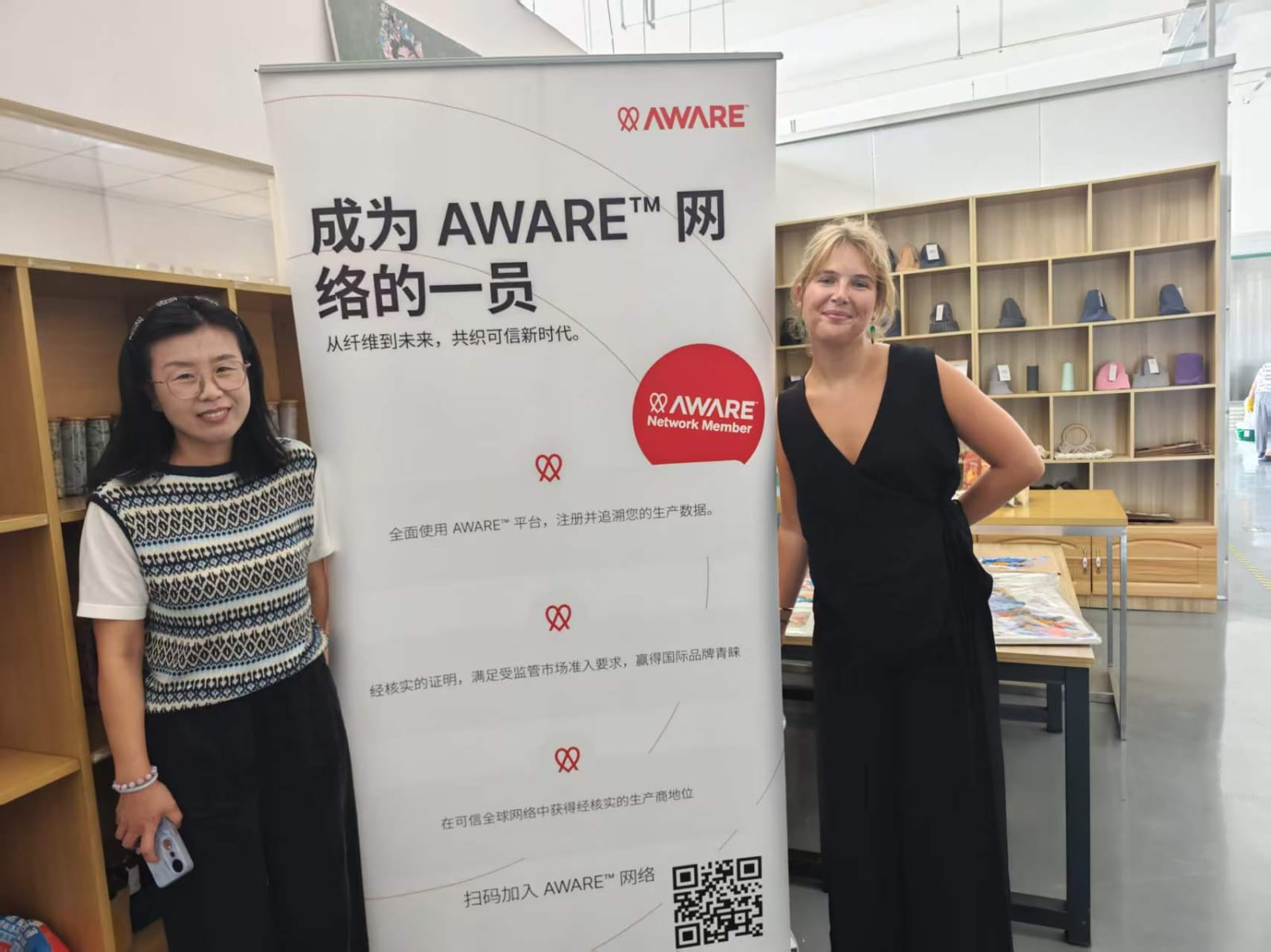
This is where AWARE™’s data infrastructure comes in.
The decree itself signals a direction. Article 8 calls for state bodies to "employ effective measures to ensure data security" and promote "information interconnection and interoperability". Article 12 requires enterprises to ensure "core technology and related information systems and data are safe and controllable". Read together, the regulation's logic points toward sovereignty at source, not extraction by a third party.
Compliance platforms that aggregate data without transmitting sensitive information across borders represent the most viable near-term solution. That description fits AWARE™ exactly.
The platform is designed for producers to provide the right information for EU and US regulation and make it verifiable. Textile producers control what data they provide, without intervention, and brands can determine for themselves in the platform if it's enough.
For Western brands, this will change their conversation with Chinese suppliers. Asking a factory to upload its production records into their system is now a harder ask - legally, politically, and practically. Asking them to tokenise their own data in AWARE™ with the data they have, and share verifiable proof on their own terms is a different proposition entirely.
Producers are going to need to think twice before adding information into ‘traceability platforms’ that give brands control over their data, and Brands are going to need to think twice about using platforms that could mean Chinese data is vulnerable.
Unless they want to lose their Chinese suppliers when they’re sanctioned by their government.
The broader context matters too.
Decree 834 arrived alongside Decree 835, which introduces enforcement powers in reaction to what China characterises as an increasingly contested geopolitical cross-border trade environment. These are not temporary measures, they reflect a structural shift in how China governs the data that flows from its factories.
We are not claiming Decree 834 was written with AWARE™ in mind. But infrastructure has consequences. A centralised platform built for frictionless data extraction now faces real friction. A decentralised model built for producer data control faces none.
Something we already have.
Get in touch to discuss and learn more.
.png)


.jpeg)
.avif)